How Does 3D Scanning Work? A Beginner’s Guide to the Technology
You have a part on the bench and no drawing for it. Or you have the drawing, and now you

For most of the twentieth century, a crime scene was preserved with a tape measure, a roll of film, and a hand sketch. Those methods still work, but they capture a fraction of what was actually there, and they freeze the investigator’s interpretation into the record before anyone has had time to ask new questions. 3D scanning in forensics changes that calculus: a crime scene, a vehicle, or a piece of evidence can be captured as a dense, measurable digital twin that any analyst, attorney, or juror can revisit long after the physical scene is gone.
This article walks through how forensic and law enforcement teams use 3D scanning for crime scene documentation, blood spatter and ballistic trajectory analysis, vehicle accident reconstruction, tool and bite mark comparison, and medical examination. It also covers the practical questions that decide whether a program succeeds: which scanners fit which jobs, how scan data interacts with chain of custody and admissibility, how to build courtroom-ready visualizations, and what training a defensible workflow requires.
Photographs flatten a three-dimensional space into a two-dimensional frame. Distances are inferred, scale depends on a reference object being in shot, and anything outside the photographer’s chosen angles is simply not recorded. A 2D sketch adds dimensions but introduces measurement error and the artist’s judgment about what mattered. Neither is wrong, but both ask the investigator to decide, in the first hour, what will turn out to be important months later in a deposition or trial.
A 3D scan inverts that problem. Instead of selecting measurements, the scanner records the whole volume as a point cloud or mesh, typically with sub-millimeter to low-millimeter accuracy depending on the instrument and range. Questions that were never anticipated at the scene can be answered from the data afterward: the angle between two doorways, the line of sight from a window, the height of an impact mark, the exact position of a casing relative to a body. The benefits that make this worth the procurement effort include:
None of this replaces traditional documentation. Photography, written notes, and physical evidence collection remain the backbone of an investigation. 3D scanning is an additive layer that makes the record richer and more durable, and it is increasingly expected by the agencies and courts that have seen what it can do.
Forensic 3D scanning spans everything from a multi-room homicide scene to a single fired cartridge case. The common thread is that the work produces measurable geometry that supports analysis and, later, explanation. The applications below are where agencies and forensic consultants see the clearest return.
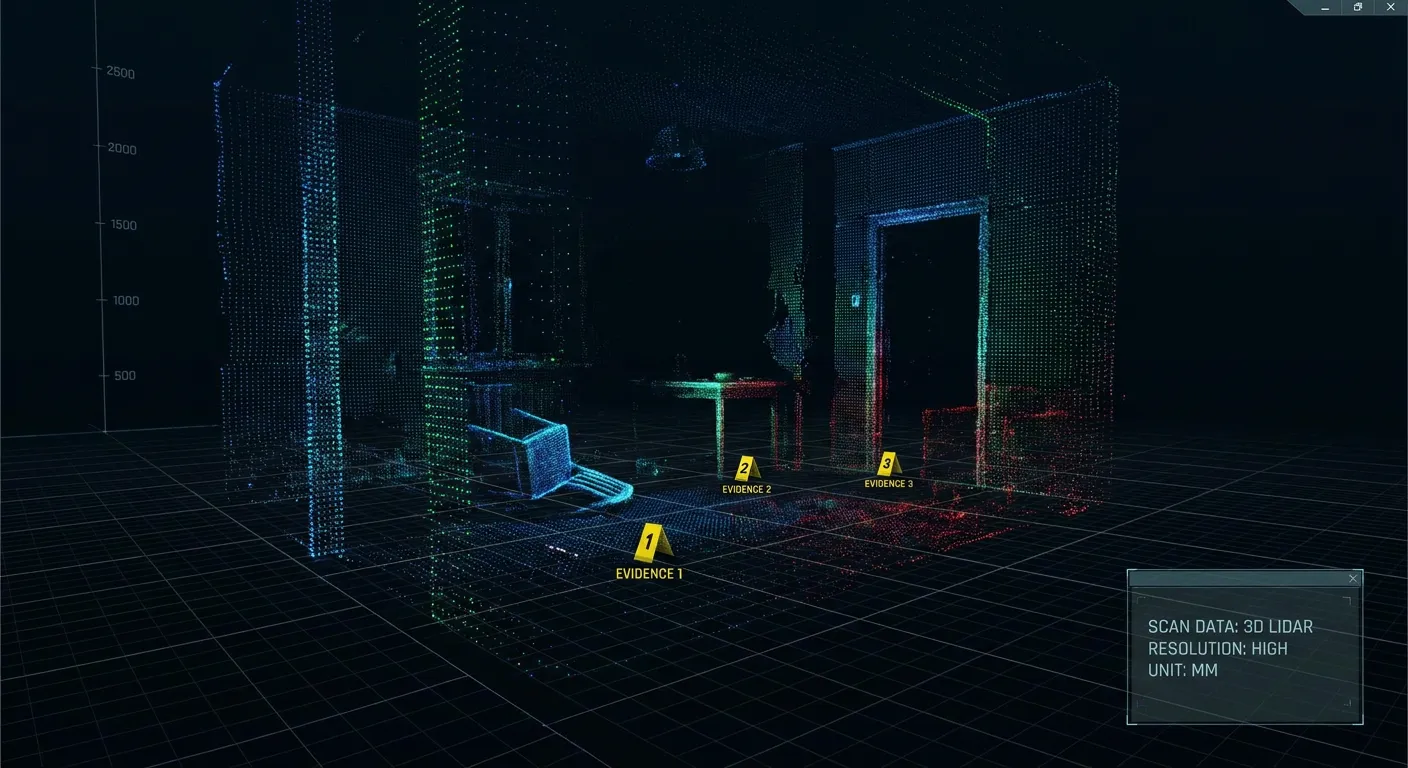
This is the anchor use case. A long-range scanner placed in several positions around a scene captures the room or area as a unified, color-mapped point cloud. Investigators get exact distances between any two recorded points, accurate floor plans and elevations, and the ability to “walk” the scene virtually. Because the capture is comprehensive, the reconstruction is built from recorded data rather than from memory or selective photographs, which strengthens the record against later challenge.
For indoor and outdoor scenes alike, the workflow is straightforward: scan from enough positions to eliminate occlusions, register the scans together using overlap or targets, and produce a clean, measurable model. From there an analyst can integrate evidence positions, sight lines, and lighting conditions. Teams that lack in-house capacity for the heavier processing or reconstruction work often pair their own capture with outside 3D scanning services to register, clean, and deliver the final deliverable.
Bloodstain pattern analysis and trajectory work are fundamentally geometric, which is why 3D capture suits them so well. For spatter, the spatial relationship between individual stains and the surfaces they struck defines the area of origin. A high-resolution capture of the stained surfaces, combined with the room geometry, lets an analyst calculate impact angles and converge on a region of origin within the measured model instead of stringing physical lines across a room.
Ballistic trajectory analysis follows the same logic. Once entry and exit points, defects in walls or furniture, and the position of a body are captured in a common coordinate system, a trajectory can be projected through the model and tested against witness accounts or alternative theories. The strength of the approach is that every input is a measured point in the same scan, so the analysis is reproducible. As always, the analyst’s methodology and qualifications determine whether a court accepts the conclusion; the scan provides accurate geometry, not a verdict.
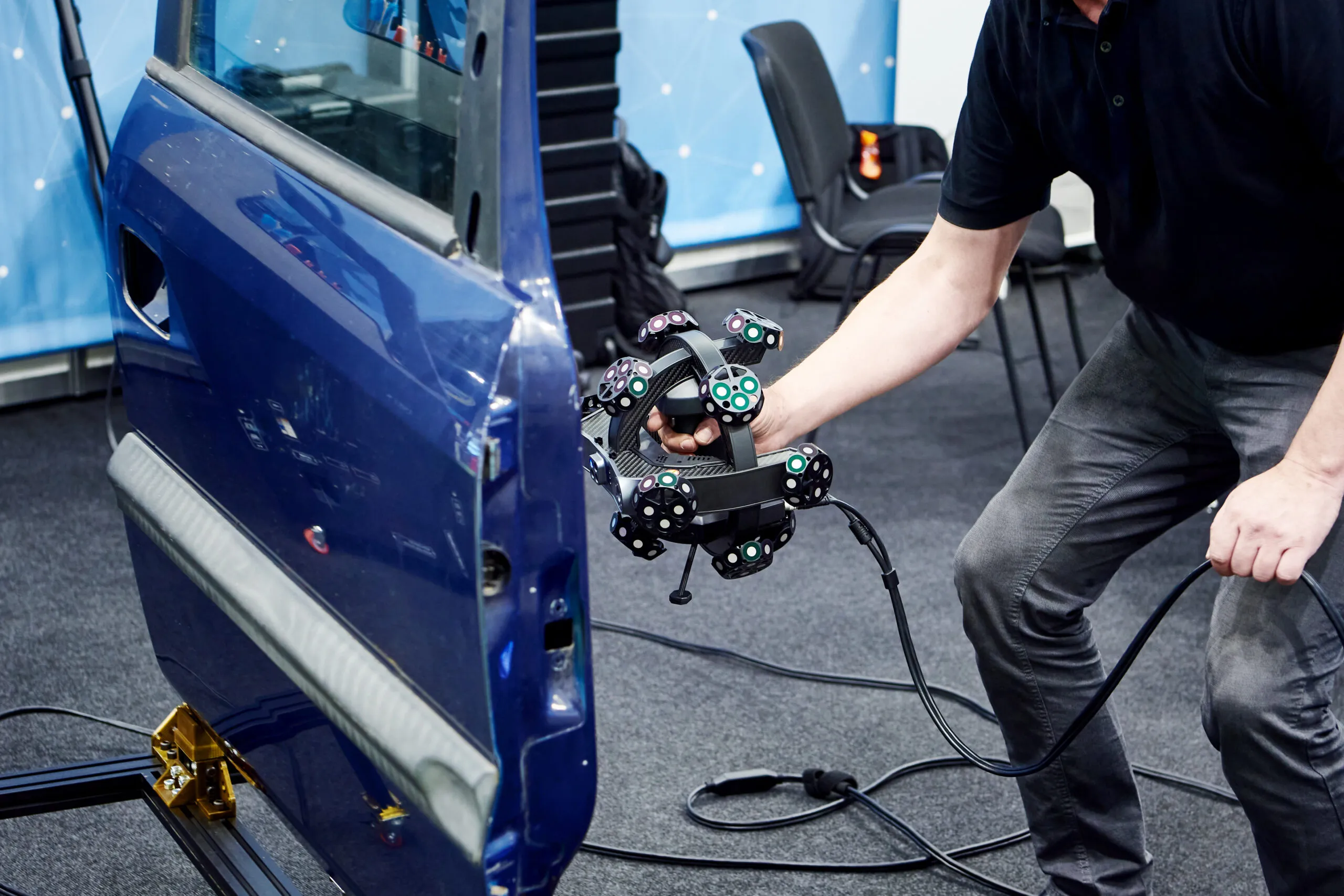
Crash and collision investigation was an early adopter of 3D scanning because roadways are expensive to keep closed and the relevant evidence, skid marks, gouges, vehicle crush, and final rest positions, is spread across a large area. A long-range scanner documents the entire scene quickly, capturing the road surface, sight distances, and grade, while a handheld unit can capture vehicle deformation in detail back at the impound lot.
Crush measurement feeds energy and speed estimates, and the combined scene-and-vehicle model lets reconstructionists evaluate visibility, point of impact, and pre-impact paths. The result is a record that supports the engineering analysis and, just as importantly, can be shown to a jury as a clear, to-scale depiction of what happened rather than a tangle of measurements.
At the opposite end of the scale from a full scene are the comparison disciplines, where the question is whether one surface made a mark on another. Here a high-resolution handheld or structured-light scanner captures the fine geometry of a striated tool mark, a pry impression, or an indentation pattern. Working from a 3D mesh rather than a 2D photograph preserves depth and contour, which matters when comparing a suspect tool against a questioned mark.
It is worth being candid about the science. Pattern-comparison disciplines such as bite mark analysis have drawn significant scrutiny, and a 3D scan does not by itself validate a contested method. What scanning does provide is a precise, documented, and re-examinable record of the evidence geometry, which supports more rigorous and transparent comparison and lets independent experts work from the same data. The instrument improves the documentation; the underlying analytical discipline still has to stand on its own.
Medical examiners and forensic pathologists use 3D scanning to document injuries, skeletal trauma, and anatomical evidence in a way that is non-contact and repeatable. A handheld scanner captures wounds, fracture patterns, and patterned injuries with color and geometry intact, creating a record that survives after autopsy and decomposition advance. When a patterned injury may correspond to a specific object, the scanned wound and the scanned object can be compared in software.
For anatomical and skeletal work where surfaces are wet, dark, or translucent, a light dusting of a vanishing scanning spray such as AESUB Violet, which is pigment-free and formulated for sensitive applications, can make a difficult surface scannable without permanently altering the evidence. The sublimating sprays leave no residue, which matters when the item must remain unaltered for the record.
There is no single forensic scanner. The right tool depends on whether you are capturing a volume or an object, and most serious programs end up with at least one long-range instrument for scenes and one handheld for evidence and bodies. Range, accuracy, resolution, portability, and how the device handles uncontrolled lighting all factor into the decision.
FactorLong-range scanner (scenes)Handheld scanner (evidence/bodies) Typical rangeRoom to dozens of metersCentimeters to a few meters Best forRooms, buildings, roadways, large outdoor scenesTool marks, wounds, casings, vehicle crush, bodies Resolution priorityCoverage and registration accuracyFine surface detail, sub-millimeter features Capture styleStationary tripod positions, registered togetherOperator sweeps the object freely On-scene speedMinutes per setup, full scene quicklySeconds to minutes per objectFor documenting a room, a building, or a stretch of roadway, a long-range scanner is the right instrument. A LiDAR-based unit such as the Artec Ray II captures large volumes from a tripod with high accuracy and low noise, then registers multiple positions into one measurable model. The priority is comprehensive coverage with reliable registration, so that distances measured across the model, doorway to body, window to impact mark, are trustworthy.
The practical advantages on scene are speed and minimal contact. The team works around the scene, not through it, and a closed roadway or building reopens faster. Because the capture is comprehensive, the cost of returning to re-measure something later drops to nearly zero; the answer is already in the data.
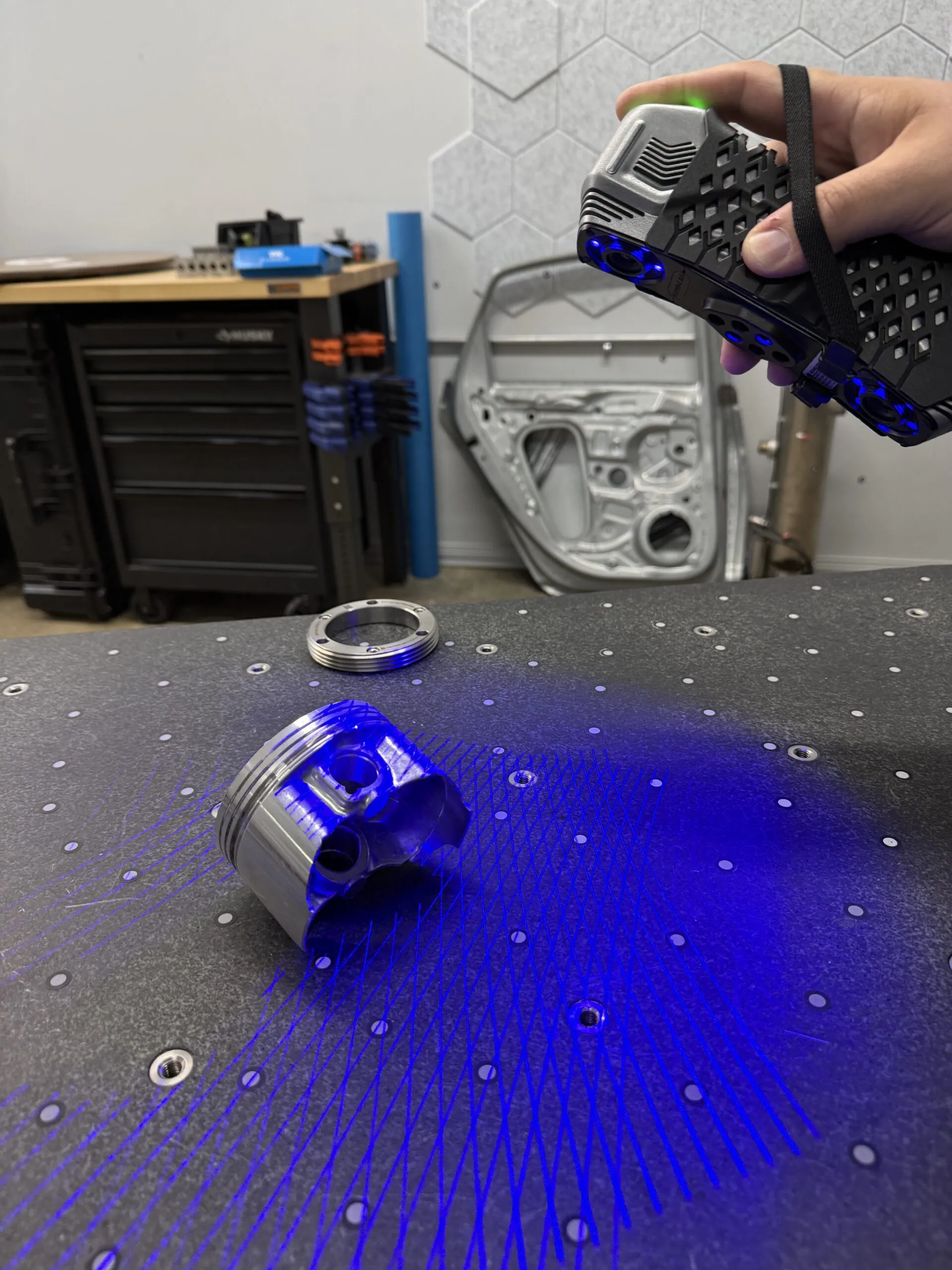
Once the scene is documented, attention turns to individual items and to bodies, where a portable, wireless handheld scanner is the better fit. A unit like the Artec Leo is wireless and self-contained, which suits the confined and awkward angles of evidence work and autopsy documentation, while a high-resolution device such as the Artec Spider II is built for small parts and fine detail like tool marks and striations. Browse the full range of portable and handheld 3D scanners to match resolution and field of view to the evidence you handle most.
Handheld scanning is non-contact, which preserves the evidence, and it captures color alongside geometry, which matters for patterned injuries and stained surfaces. For dark, glossy, or translucent items, a quickly sublimating scanning spray restores a scannable surface without leaving residue. The goal in every case is a clean, high-fidelity mesh that can be measured, compared, and presented without anyone having to handle the original again.
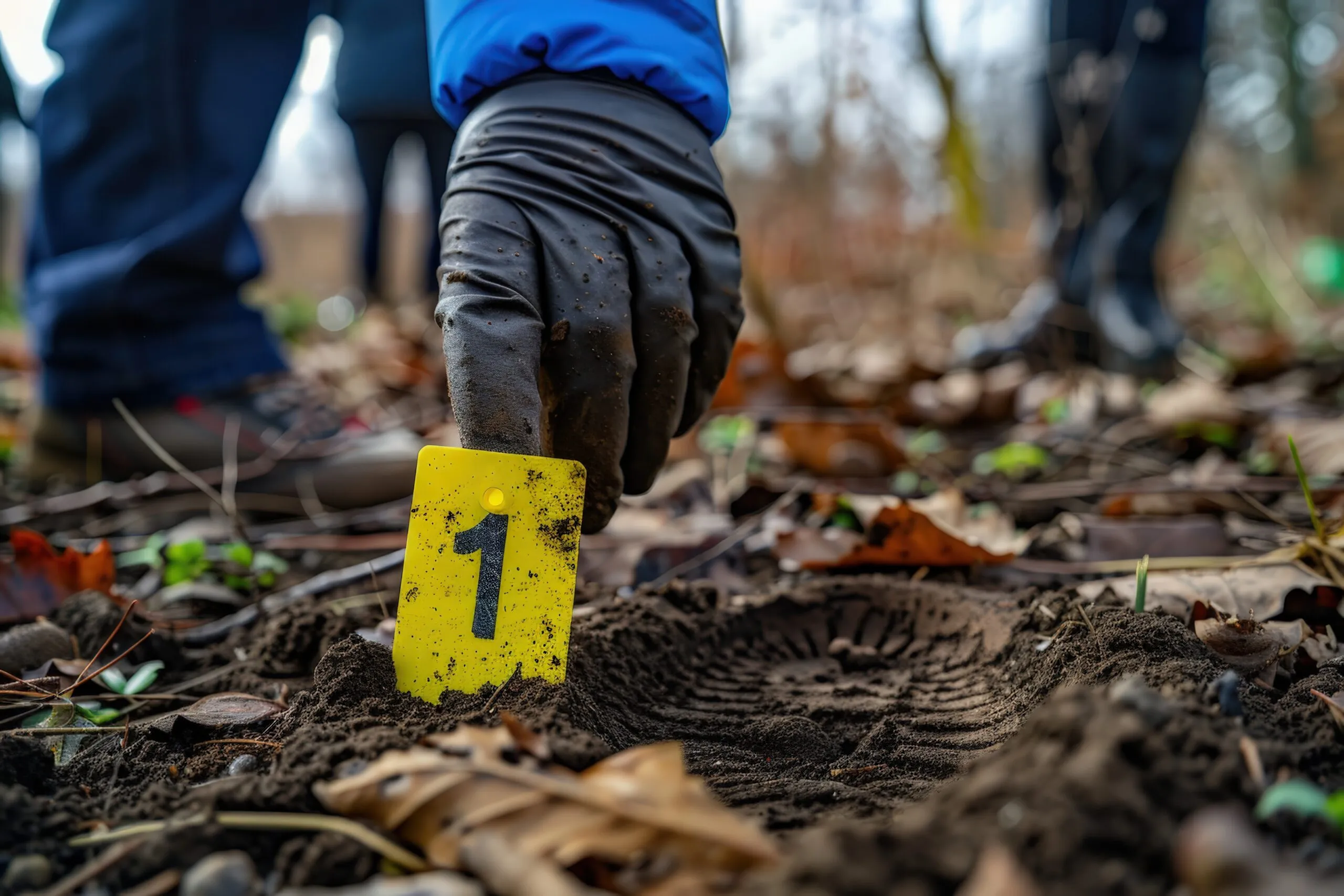
A scan is only as useful as it is defensible. Digital evidence raises the same questions as physical evidence, who collected it, how, when, and whether it could have been altered, plus a few that are specific to data. Building chain of custody into the scanning workflow from the start is far easier than reconstructing it later under cross-examination. In practice that means:
On admissibility, it is important to be precise and not to overpromise. Whether scan-derived evidence is admitted depends on the jurisdiction, the rules of evidence in play, the reliability of the methodology, and the qualifications of the witness presenting it, factors that no scanner can guarantee. What an accurate, well-documented, reproducible scanning workflow does is give the analyst the strongest possible foundation to lay. The geometry is sound and traceable; the legal standard is met by people and process, not by the hardware alone. Treat any vendor claim that a tool is “court-proof” with skepticism.
The same data that supports rigorous analysis also makes for powerful, comprehensible exhibits, and this is often where 3D scanning earns its keep with prosecutors and triers of fact. A jury that struggles to assemble a scene from a dozen photographs can immediately grasp a to-scale model, a measured cross-section, or a slow virtual walkthrough. The capture lets the analyst show, rather than merely assert, the spatial relationships at the heart of the case.
Effective courtroom visualization follows a few principles. Exhibits should be clearly labeled as derived from the measured scan data, and any element that is interpretation rather than captured fact, a projected trajectory, an inferred area of origin, should be presented as such. Demonstratives must remain faithful to the underlying measurements; the credibility that makes a 3D exhibit persuasive evaporates the moment opposing counsel shows it exaggerates or omits. Useful courtroom outputs include:
The technology is only half of a defensible program; the operator is the other half. A scanner in untrained hands can produce incomplete coverage, poor registration, or measurements whose uncertainty no one can explain on the stand. Agencies that adopt scanning successfully invest in training their personnel to capture clean data, process it correctly, and articulate the workflow and its limits clearly.
Practical competency spans field technique, scan registration and processing, and an honest understanding of accuracy and error so the operator can answer for the data under cross-examination. Because measurement and tolerance literacy underpins all of it, foundational instruction such as GD&T basics training helps operators reason precisely about what their numbers mean. When an agency is building capability, it is often fastest to combine formal instrument training with hands-on mentoring from experienced practitioners, and to lean on outside expertise for the more demanding processing until the in-house team is fully up to speed.
Adoption across law enforcement and medical examiner offices tends to follow a recognizable arc rather than a single dramatic rollout, and understanding that pattern helps a new program budget and plan realistically. Agencies typically begin with a high-value, geometry-heavy application, most often crash reconstruction or major-crime scene documentation, where the time savings and evidentiary strength are easiest to demonstrate. A successful first deployment then builds the internal case for expanding into spatter analysis, evidence comparison, and medical examination work.
Because procurement runs on government budget and grant cycles, the path from interest to deployment is usually measured in quarters, not weeks, and benefits from a clear-eyed plan: which scanners for which applications, what training the team needs, how data will be stored and protected, and how deliverables will hold up in court. Rather than lean on any single vendor’s success story, evaluate the technology against your own caseload and evidence rules, and pilot it on real cases before committing across the agency. The right scope of equipment and process is what turns a promising demo into a durable, defensible capability.
Forensic and law enforcement teams need accurate capture, defensible data, and the expertise to turn scans into measurable, presentable evidence. Digitize Designs supplies both the equipment and the know-how: long-range scanners for full-scene documentation, high-resolution handheld 3D scanners for evidence and bodies, and the consumables and software that complete the workflow. Where your team would rather outsource capture, registration, or reconstruction, our 3D scanning services can deliver clean, measurable models from your scenes and evidence.
Whether you are standing up a new scanning program or upgrading an existing one, our engineers can help you match the right instruments and training to your caseload, your evidence rules, and your procurement timeline. Contact us for a consultation or a quote, and we will help you build a forensic scanning capability that holds up in the field and in court.
You have a part on the bench and no drawing for it. Or you have the drawing, and now you
A fender comes off the press and something is off. The hole pattern checks out on the CMM and every
If you have ever searched for a way to turn a physical object into a digital model, you have probably
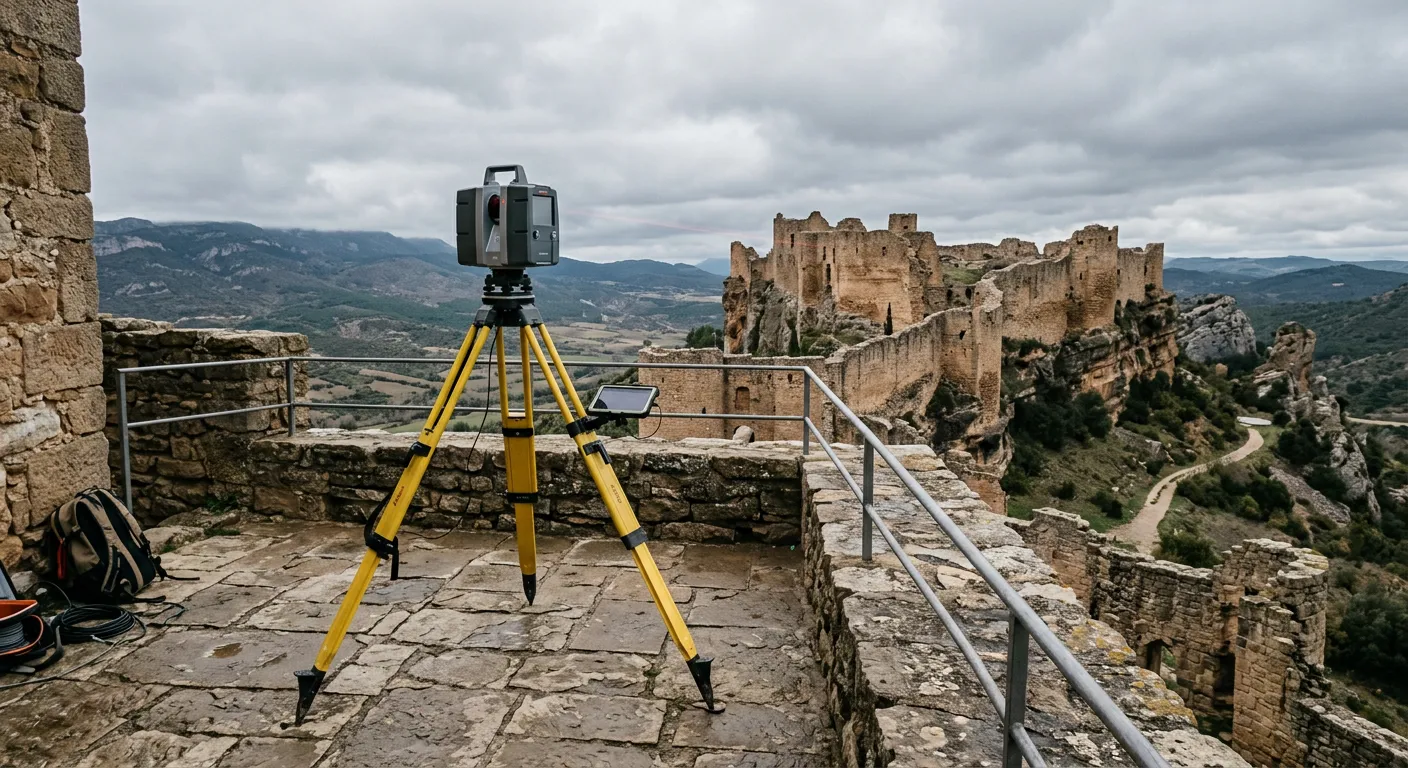
Every artifact and monument is on a clock. Stone weathers, pigments fade, bronze corrodes, and a single earthquake, flood, or